How to Choose the Right Wireless Channel Bandwidth: Speed, Coverage and Interference
When designing a wireless network, bigger bandwidth does not always mean better performance.
Channel bandwidth is one of the key factors affecting network speed, coverage and stability. Whether deploying a Wi-Fi network, 4G/5G router or wireless CPE solution, choosing the right bandwidth requires balancing multiple factors rather than simply selecting the widest channel available.
So, how does channel bandwidth work, and how should you choose the right one?
1. The Basic Logic: Bandwidth Sets the Upper Limit of Data Speed
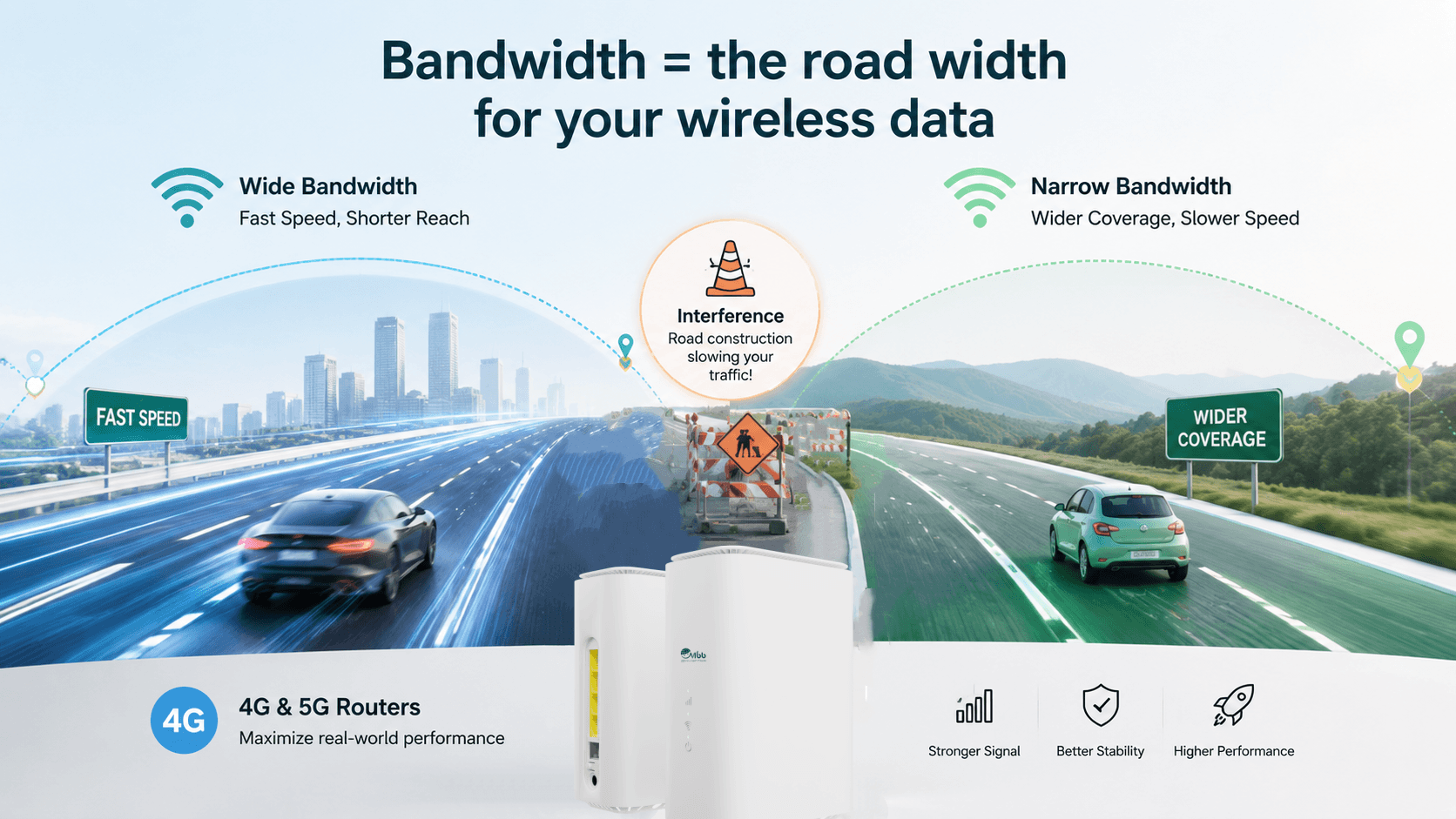
Channel bandwidth can be compared to the width of a highway.
A wider highway provides more lanes for vehicles. Similarly, a wider wireless channel can carry more data simultaneously.
- Wider bandwidth → Higher potential data throughput
- Narrower bandwidth → Lower theoretical maximum speed
For example, a wider channel can support high-throughput applications such as HD video streaming, large file transfers or VR/AR experiences.
However, higher bandwidth does not automatically guarantee better real-world performance.
2. The Three Key Trade-Offs: Speed, Coverage and Interference
Choosing channel bandwidth is always a balancing process between three important factors.
1) Data Speed
Bandwidth directly affects the maximum amount of data that can be transmitted.
Applications such as video streaming, cloud services and high-speed internet access may require wider channels to deliver a better user experience.
2) Coverage Distance
Wider bandwidth is often associated with higher throughput, while narrower bandwidth can be more suitable for stable and longer-distance communication.
For example:
- Narrower bandwidth → Better efficiency for coverage-oriented deployments
- Wider bandwidth → Higher throughput for high-speed applications
Therefore, network designers should not sacrifice coverage simply to achieve higher peak speeds.
3) Environmental Interference
Wireless environments are rarely ideal.
Co-channel interference, adjacent-channel interference and dynamic environmental interference can all reduce actual network performance.
A wider channel occupies more spectrum resources, which may increase the risk of interference in crowded wireless environments.
This means the theoretically fastest configuration may not always provide the best real-world user experience.
3. There Is No Universal “Best” Bandwidth
Different applications have completely different requirements.
| Application | Bandwidth Direction | Core Requirement |
|---|---|---|
| Smart Home | Low bandwidth | Stable and sufficient connectivity |
| Video Streaming | Medium to high bandwidth | Smooth and high-speed transmission |
| Industrial Control | Stable bandwidth | Low latency and high reliability |
| VR/AR | Ultra-high bandwidth | Maximum throughput and immersive experience |
4. Choosing Bandwidth Based on Real Deployment Needs
Before selecting a channel bandwidth, network operators and device providers should evaluate:
- How much data throughput does the application actually require?
- What coverage distance is needed?
- How congested is the wireless environment?
- Are stability and reliability more important than peak speed?
- How many devices will connect simultaneously?
For consumer applications, users may prioritize speed and multimedia performance.
For industrial or IoT applications, stable connectivity and reliability may be more important than maximum throughput.
For FWA and wireless broadband deployments, operators often need to balance capacity, coverage and spectrum efficiency.
Conclusion
There is no universally optimal channel bandwidth.
The widest bandwidth may deliver higher theoretical speeds, but it may not always provide the best coverage or stability. Narrower bandwidth may sacrifice peak throughput but can be a better choice in environments where coverage, reliability or spectrum efficiency is more important.
The best channel bandwidth is not the widest one—it is the one that best matches your application, business requirements and real-world deployment environment.
For wireless routers, 4G/5G CPE and FWA solutions, successful network performance depends on finding the right balance between speed, coverage and interference.