5G FWA Is Growing — But What Makes a Good 5G CPE?
Beyond Speed: 5 Key Factors to Consider When Choosing a 5G CPE for FWA
The global Fixed Wireless Access (FWA) market is moving into a new stage.
According to the latest 2026 FWA CPE market survey from the Global mobile Suppliers Association (GSA), global FWA CPE shipments are expected to reach 23 million units in 2026, representing 16% growth year over year. 5G-enabled devices are expected to account for approximately 69% of total FWA CPE shipments, up from 60% in 2025.
The numbers are encouraging.
But as 5G FWA becomes more competitive, an important question is emerging:
What actually makes a good 5G CPE?
The answer is not simply maximum download speed.
For operators, ISPs, WISPs, distributors and networking brands, choosing the right 5G CPE requires a balance between network compatibility, real-world performance, Wi-Fi capability, reliability and cost.
Here are five factors worth considering.
1. Network Compatibility Comes First
A 5G CPE may look impressive on a specification sheet, but if it does not work well with the target operator's network, its theoretical performance means very little.
Before selecting a 5G CPE, businesses should consider:
- Supported 5G bands
- 4G LTE fallback
- 5G SA and NSA support
- Carrier aggregation
- Regional frequency requirements
- Operator compatibility
- Network signal conditions
This is especially important for international markets.
A 5G CPE designed for Europe may not necessarily be the best choice for Southeast Asia or Latin America.
Therefore, regional network compatibility should be evaluated before peak speed.
For FWA providers, successful deployment is ultimately about delivering a stable connection to real users on real networks.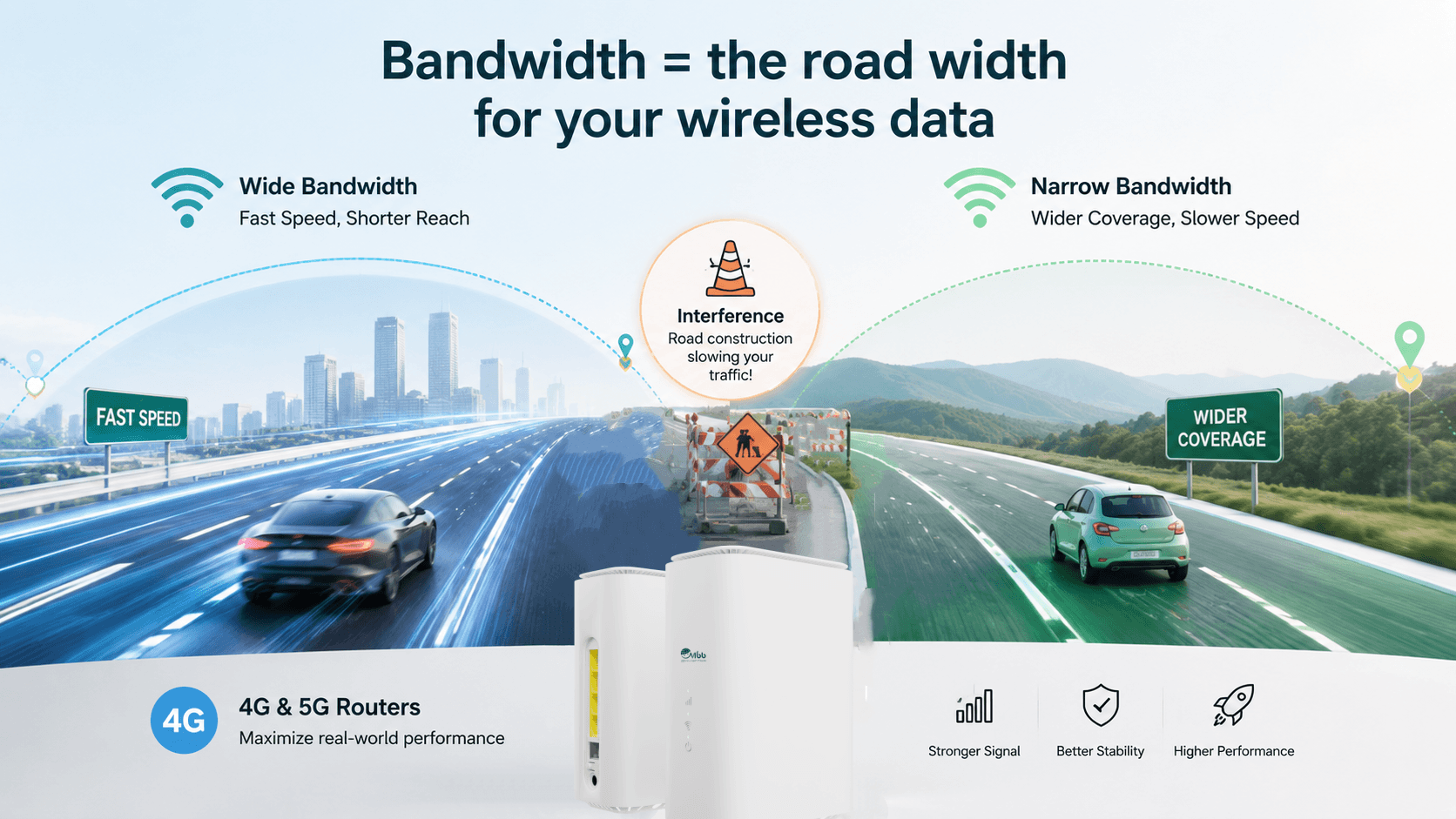
2. Peak Speed Is Not the Same as Real-World Performance
One of the most common ways to compare 5G routers is by looking at the maximum theoretical speed.
But users don't experience a specification sheet.
They experience:
Download → Upload → Latency → Stability → Wi-Fi performance
Actual FWA performance can be affected by:
- Signal strength
- Network congestion
- Spectrum availability
- Antenna design
- Device placement
- Thermal performance
- Network configuration
This means a CPE with an extremely high theoretical speed is not automatically the best solution.
For many FWA deployments, stable and consistent performance can be more valuable than a higher peak number.
That is particularly important for home broadband, small businesses, CCTV and other applications that require a reliable connection throughout the day.
3. The Cellular Connection Is Only One Part of the Experience
A 5G CPE does not stop at the cellular modem.
Once the device receives the 5G signal, it still needs to deliver that connection efficiently to the user's devices.
This is where Wi-Fi becomes critical.
A high-performance 5G CPE may combine:
- 5G cellular connectivity
- Wi-Fi 5 or Wi-Fi 6
- Dual-band Wi-Fi
- Multiple Ethernet ports
- Local network management
- Security features
Imagine a CPE receiving a very fast 5G connection but providing weak Wi-Fi coverage inside the home.
The user will not experience the full value of the 5G network.
So when evaluating a 5G CPE router, it is important to look at the entire connectivity chain:
5G Network → CPE → Wi-Fi/Ethernet → End Devices
Not just the first step.
The industry is already moving toward more advanced CPE architectures combining 5G-Advanced, AI capabilities, Wi-Fi 8 and even satellite connectivity, showing that the CPE itself is becoming an increasingly important part of the connectivity ecosystem.
4. Ethernet Still Matters
Wireless does not mean everything needs to be wireless.
For many FWA users, Ethernet remains essential.
A home or small business may connect:
- Desktop PCs
- Smart TVs
- IP cameras
- POS terminals
- Network storage
- Gaming devices
- Access points
- Other wired networking equipment
This makes the number and type of Ethernet interfaces an important consideration when choosing a CPE.
For example, an entry-level CPE with a single Ethernet port may be suitable for basic internet access.
A business-oriented or smart-home CPE may benefit from multiple LAN ports.
The right configuration depends on the target market.
There is no single “best” CPE specification for every application.
5. Cost-to-Performance May Be the Most Important Factor
This is where the FWA market becomes particularly interesting.
The fastest CPE is not necessarily the most commercially successful CPE.
For many emerging markets, customers and service providers need to balance:
Performance + Coverage + Reliability + Features + Cost
This is why different CPE categories will continue to coexist.
Entry-level 4G CPE
Designed for affordable broadband and markets where 4G remains widely available.
4G Cat 6 CPE
A step up for customers who need higher LTE performance.
5G CPE
Designed for higher-speed broadband, premium FWA and markets with expanding 5G coverage.
5G RedCap
Designed for specific applications where full 5G performance is unnecessary but reliable cellular connectivity is important.
The latest GSA survey also expects 5G RedCap FWA shipments to grow nearly fourfold in 2026, although from a much smaller base.
The takeaway is simple:
The best CPE is not necessarily the fastest CPE. It is the CPE that delivers the right performance at the right cost for the target market.

Indoor CPE or Outdoor CPE?
Another important decision for FWA providers is whether to deploy an indoor CPE or outdoor CPE/ODU.
Indoor CPE
Indoor CPE is generally easier to install and more convenient for end users.
It can be particularly suitable for:
- Urban and suburban homes
- Apartments
- Small offices
- Self-install deployments
- Strong-signal environments
Interestingly, GSA's latest survey expects integrated indoor CPE to account for 64% of FWA CPE shipments in 2026, up from 57% in 2025.
Outdoor CPE / ODU
Outdoor solutions can make more sense when:
- Indoor signal strength is weak
- The customer is located far from the cell site
- Higher antenna performance is required
- Environmental conditions make indoor reception difficult
The choice therefore depends heavily on the deployment environment.
What Should CPE Brands Look for in 2026?
For networking brands, distributors and ISPs developing an FWA product portfolio, the key questions are no longer simply:
“How fast is the router?”
Instead, consider:
1. Does it support the right local 4G/5G bands?
2. Does it deliver stable real-world performance?
3. Can the Wi-Fi network match the cellular connection?
4. Does it provide the right Ethernet configuration?
5. Is the cost appropriate for the target market?
6. Can the product be customized for a specific operator, ISP or brand?
These questions are becoming increasingly important as the FWA market becomes more mature.
One CPE Does Not Fit Every Market
A broadband provider in Europe may have very different requirements from a WISP in Latin America.
An e-commerce brand in Southeast Asia may prioritize affordability and compact design.
A smart-home company may need multiple Ethernet ports for CCTV and IoT devices.
An ISP may require specific network bands, firmware customization and remote management.
Therefore, the future of the CPE market is unlikely to be about creating one universal product.
Instead, it will be about developing the right CPE for the right market.
This is where OEM and ODM cooperation can create additional value.
From 4G LTE to 5G: Building the Right CPE Portfolio
The wireless broadband market is evolving, but 4G is not disappearing overnight.
A practical CPE portfolio may include:
4G Cat 4 → Affordable LTE broadband
4G Cat 6 → Higher-performance LTE
5G → High-speed FWA
5G RedCap → Lightweight 5G connectivity
5G-Advanced → Next-generation broadband applications
This allows brands and connectivity providers to target different markets instead of relying on a single technology.
The Future of FWA Is Not Just About Faster Networks
The growth of 5G FWA is creating opportunities across the entire CPE ecosystem.
But the next stage of competition will not simply be:
Who has the fastest 5G router?
It will increasingly be:
Who can deliver the right connectivity experience at the right price?
Network compatibility.
Real-world performance.
Wi-Fi capability.
Ethernet connectivity.
Reliability.
Cost.
Customization.
All of these factors matter.
At SmileMBB, we develop 4G LTE and 5G CPE solutions for global networking brands, ISPs, distributors and connectivity providers, with OEM/ODM capabilities for different market requirements.
From cost-effective 4G LTE CPE to high-performance 5G indoor CPE, the goal is simple:
Build the right connectivity solution for the right market.
Final Thought
5G FWA is growing. But the future of FWA will be shaped not only by the network, but also by the CPE sitting in every home, office and business.
The question is no longer:
“How fast can 5G go?”
The better question is:
“How well can a 5G CPE turn that network performance into a reliable everyday experience?”